Agility drills rely on equipment ranging from simple footwork tools to complex, reactive systems. Traditional ladders focus on repetitive speed, while modern pods and circular designs force your brain to react to changing signals. These tools help you build better control, rhythm, and explosive movement in any sport.
Best overall: SKLZ Speed Agility Ladder, which provides a straightforward, durable design with 11 heavy-duty rungs that help athletes improve their foot strike frequency and overall body control during standard speed drills.
Best for reactive training: BlazePod Reaction Training Kit, which uses smart pods and an app to challenge your cognitive agility and reaction time through customizable, measurable drills designed for professional-level performance.
Best for unconventional movement: Webby Agility Trainer, a circular ladder design that helps athletes move more effectively at angles by breaking away from the limitations of linear, traditional training equipment.
This guide is for athletes, coaches, and fitness fans who want to improve their speed and coordination using reliable, purpose-built gear.
How We Picked
We compared 48 different Amazon listings to find the most effective tools for agility training. To earn a spot, each product had to clearly state its key specifications, including dimensions, materials, and what exactly comes in the box. We excluded any listings that lacked clear details on how the product functions or what it’s designed to achieve. Our selections focus on gear that serves a specific purpose, whether for repetitive footwork or complex reactive drills.
All 10 products side by side — scroll sideways to see every column.
| Top Pick | Best for Cognitive Speed | Best for Reactive Footwork | Best for Speed Rings | Best for Hurdle Drills | Best for Weaving Drills | Best for Reflex Training | Best for Quick Setup | |||
| Preview | 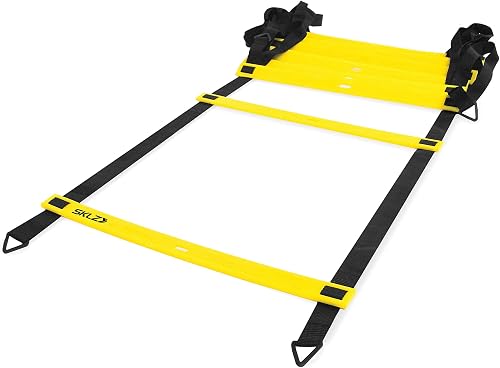 | 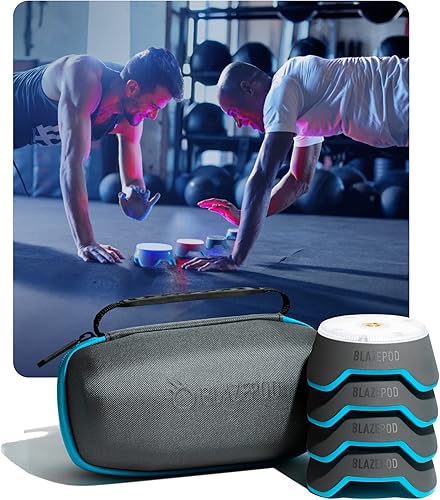 |  | 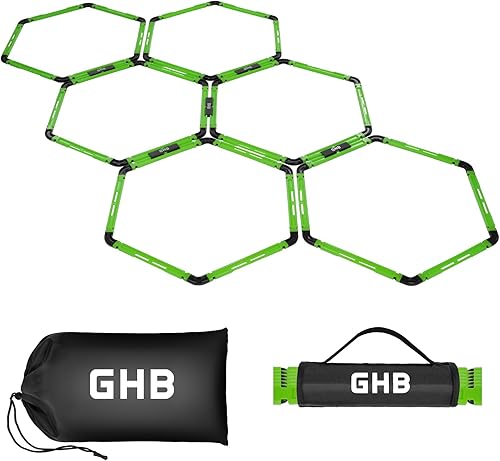 |  |  |  |  |  | 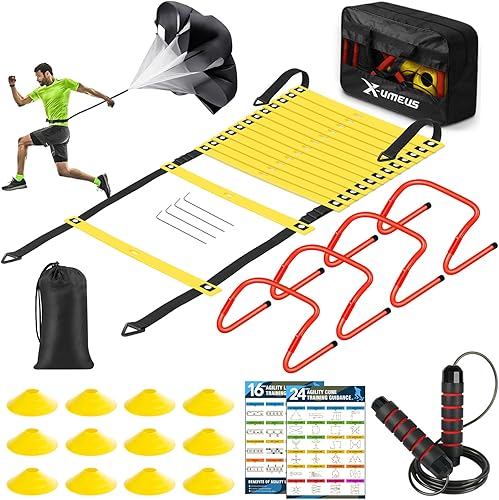 |
|---|---|---|---|---|---|---|---|---|---|---|
| Product | SKLZ Speed Agility Ladder | BlazePod Reaction Training Kit | Webby Agility Trainer | GHB Hex Agility Rings | GHB Agility Hurdles | GHB Soccer Training Poles | SKLZ Reaction Ball | GHB Rubber Agility Mat | SOFTSOUL Tangle Free Ladder | Agility Speed Training Set |
| Brand | Not stated | BlazePod | Webby | GHB | GHB | GHB | SKLZ | GHB | SOFTSOUL | X-UMEUS |
| Best for | Best Overall | Best for Cognitive Speed | Best for Reactive Footwork | Best for Speed Rings | Best for Hurdle Drills | Best for Weaving Drills | Best for Reflex Training | — | Best for Quick Setup | — |
| The listing says | Improves acceleration and lateral speed Enhances foot strike and lift frequency | Improves focus, speed, and cognitive agility App-controlled drills and progress tracking | Circular design for multi-directional movement Self-erecting shape prevents bunching | 6 hexagonal rings with 21" diameter Detachable design for quick installation | Lightweight 250g PVC construction Suitable for various sports training | 20' ladder with 12 adjustable rungs 6 poles at 5.9ft with spring-loaded spikes | Six-sided ball for random bounce feedback Use against walls or between players | 3mm thick rubber construction 15' length, 13.39" or 15.74" width | Fixed rungs prevent tangling Reinforced plastic for durability | Includes 20ft ladder, 4 hurdles, 12 cones, parachute, jump rope Suitable for all ages and skill levels |
| More information | Check Price on Amazon | Check Price on Amazon | Check Price on Amazon | Check Price on Amazon | Check Price on Amazon | Check Price on Amazon | Check Price on Amazon | Check Price on Amazon | Check Price on Amazon | Check Price on Amazon |
1. SKLZ Speed Agility Ladder
Best for: Athletes needing a reliable, standard speed ladder.
This ladder is a classic tool for improving acceleration and lateral speed. It features 11 heavy-duty plastic rungs that are 17 inches wide, providing a clear space to practice your footwork. The 15-foot length gives you enough room for a variety of drills, and the included carry bag makes it easy to take to the field.
Because the rungs are fixed to the straps, you can focus on your foot strike and lift frequency without worrying about the ladder shifting. If your training requires high-intensity footwork, prioritize keeping your strikes centered within the 17-inch width to maximize rhythm and balance. Beginners often make the mistake of rushing the pattern, which sacrifices body control. Slow down your cadence until you can maintain consistent contact; speed will naturally follow as your coordination improves.
This is a linear tool, so it isn’t for athletes who need to train for multi-directional or reactive movements. If your sport requires sudden lateral cuts or complex agility patterns, use this ladder to build your base, then transition to open-field drills.
Pros
- Simple, durable plastic rung design.
- Includes a convenient carry bag.
- Large 15-foot training length.
Cons
- Linear design limits movement patterns.
2. BlazePod Reaction Training Kit Smart Pods
Best for: Trainers and athletes focusing on cognitive speed.
This kit uses four smart pods to turn every drill into a measurable challenge. By connecting to the BlazePod app, you can access hundreds of drills that force you to react to light signals, improving your focus and speed. The pods are splashproof and designed to be used in almost any environment.
If you’re training solo, use the pods to track your own reaction times and balance improvements. In group settings, the system allows coaches to manage multiple athletes simultaneously, turning drills into competitive, data-driven sessions. If you can’t access the app, you’ll lose the ability to customize sessions or record your performance metrics.
Since the system tracks your data, it is designed for athletes who want to utilize app-based performance metrics. It is not for those who prefer low-tech, manual equipment, as the pods require charging and app integration to function.
Pros
- Professional-grade, measurable reaction drills.
- Durable, splashproof pod construction.
- Extensive app-based training library.
Cons
- Requires app and charging.
- Not suitable for offline, manual training.
3. Webby Agility Trainer
Best for: Athletes training for angular, multi-directional movement.
The Webby is a unique circular ladder designed by UFC fighter Jason “Dooms” Day to help you move more powerfully at any angle. Its patented design allows it to self-erect and hold its shape, so you spend more time training and less time adjusting the equipment. It folds down from a 6-foot circle to a compact 18-inch size for storage.
Sport is inherently angular, not linear. If you find your footwork stalling during lateral transitions, this tool forces your body to adapt to non-linear patterns. Use the Webby when you need to move beyond standard straight-line drills to improve your reactive efficiency.
Avoid this equipment if you’re still mastering basic, linear footwork. The circular layout demands advanced coordination that can frustrate novices. If you’re a beginner, stick to traditional ladders until your base speed is consistent. If you’re an experienced athlete, use the circular path to retrain your body for the unpredictable nature of competition.
Pros
- Unique, self-erecting circular design.
- Folds into a compact 18-inch circle.
- Designed for multi-directional movement.
Cons
- Steeper learning curve for beginners.
4. GHB Hex Agility Rings Speed Rings with Carrying Bag 6
Best for: Creating custom, multi-shaped obstacle courses.
These six hexagonal rings have a 21-inch diameter and can be connected in any order using the five provided clips per ring. The detachable design allows you to break the set down for transport or keep them assembled using the included storage bags. If you prefer a permanent setup, use the small portable bag; if you frequently change your drills, use the larger bag to store the detached pieces.
You can change their shape and function to suit different speed and agility needs. This modularity is perfect for ladder footwork or basketball training drills that require specific, non-linear patterns.
The flexibility of these rings allows for a wide range of creative drills. They aren’t for athletes who need a single, long piece of equipment, as the focus here is on modular, short-range footwork patterns. If you need a standard straight-line ladder, look elsewhere. Use these only when your training requires a shifting, custom layout.
Pros
- Modular, connectable hexagonal design.
- Easy to detach and store.
- Flexible layout options.
Cons
- Requires assembly for different shapes.
5. GHB Agility Hurdles 8″ Speed Agility Training Hurdles
Best for: Improving explosive power and vertical lift.
This 10-pack of hurdles is made from lightweight, weatherproof PVC, making them easy to move around. Each hurdle stands 8 inches high and is bright neon orange for high visibility, whether you’re training indoors or on an outdoor field. They’re detachable, which helps you save space in your gym bag.
These are perfect for plyometric and power-focused training. Because they are 8 inches tall, they aren’t for athletes looking to practice high-jumping or hurdle techniques that require much taller obstacles. If you need to focus on rapid footwork or coordination, the 19-inch width provides enough clearance for most lateral drills.
Use the included carry strap to bundle the hurdles together for quick transport if you’re in a rush.
Pros
- Lightweight, weatherproof PVC material.
- High-visibility neon orange color.
- Detachable for easy storage.
Cons
- Fixed at a single height.
6. GHB Soccer Agility Training Equipment 6 Agility Poles
Best for: Weaving drills and agility maneuvering.
This set includes six 5.9-foot poles that can be broken down into four 15.75-inch sections each. They feature spring-loaded spikes measuring 7.87 inches, which provide stability when you stick them into the ground. The kit also includes a 20-foot speed ladder, 12 disc cones, a resistance parachute, a jump rope, and five resistance bands.
The poles are excellent for creating weaving patterns that mimic defenders. If you’re training on soft turf or grass, use the spikes for a firm anchor. The listing doesn’t mention how to stabilize the poles on hard surfaces.
This set isn’t for athletes with very limited storage space. Because the kit contains 24 total pole sections, a ladder, and numerous accessories, it requires more room than a simple ladder alone. If you struggle to fit gear in your trunk, organize the components in the provided carry bag immediately after your session.
Pros
- Includes poles, ladder, and cones.
- Poles feature stable, spring-loaded spikes.
- Adjustable height and multiple sections.
Cons
- Takes up more storage space.
7. SKLZ Reaction Ball -Baseball and Softball Reflex and Agility Trainer
Best for: Improving hand-eye coordination and reflexes.
The Reaction Ball is a six-sided rubber ball designed to bounce in unpredictable directions. This forces you to react quickly to every hop. You can bounce it against any hard surface or volley it with a partner to test your reflexes. It’s a simple, effective way to sharpen your focus before you hit the field.
Because the bounce is erratic, it’s ideal for fielding and reaction speed drills. If you’re working on fundamentals, use a wall for independent practice. If you’re working on team dynamics, volley the ball back and forth to force faster engagement.
This tool isn’t for athletes who need a stable training surface or predictable ball movement. If your goal is to master basic mechanics, stick to standard drills first. Only move to the Reaction Ball once you have the basics down, as the random movement is meant to challenge advanced reflexes.
Pros
- Unpredictable bounce improves reflexes.
- Durable, high-bounce rubber material.
- Works against any hard surface.
Cons
- Bounce is intentionally erratic.
8. GHB Rubber Agility Ladder Mat Non-Slip Speed Training
Best for: Athletes training on gym floors who hate slipping.
This 15-foot rubber mat provides a stable, non-slip surface for footwork drills. Unlike traditional ladders with nylon straps, it doesn’t bunch up or tangle, so you can focus entirely on your speed. It rolls out flat and offers two width options of 13.39 or 15.74 inches, making it versatile for different types of movement.
The 3mm rubber construction remains stable on indoor surfaces. If you train on grass or dirt, choose a different tool; this mat is engineered specifically for flat, indoor gym floors where it won’t deform. You can select between 34cm or 40cm rung spacing to accommodate different user groups.
At 3.31 pounds, the mat is easy to transport in its carrying bag.
Pros
- Stable, non-slip rubber construction.
- Doesn’t tangle or bunch.
- Rolls out flat for training.
Cons
- Best suited for indoor use.
- Requires flat, level surfaces for optimal performance.
9. SOFTSOUL Tangle Free Agility Ladder
Best for: Athletes who want a quick, mess-free setup.
This ladder features fixed rungs that stay flat and evenly spaced, so you never have to deal with knots or tangled straps. Built-in support rods keep the straps stiff, ensuring the ladder is ready for drills in seconds. It’s built to last, with reinforced plastic rungs that resist cracking or warping on concrete, turf, or gym floors. It folds up quickly and fits into a drawstring bag for easy carrying.
The fixed design saves significant time during practice. If your training requires consistent, standard spacing for speed and coordination drills, this ladder is the ideal choice. However, it isn’t for athletes who need to adjust the space between rungs for specific, non-standard footwork patterns, as the spacing here is permanent. Trying to force custom spacing on this model will only lead to frustration and potential damage to the support rods.
Pros
- Fixed rungs prevent tangling.
- Durable, reinforced plastic construction.
- Extremely fast setup time.
Cons
- Rung spacing can’t be adjusted.
10. Agility Ladder Speed Training Equipment Set-20ft Agility Ladder
Best for: Athletes wanting a total, all-in-one training solution.
This kit contains everything from a 20-foot ladder and adjustable hurdles to a jump rope and running parachute. It’s designed for all ages and skill levels, providing the tools to improve balance, explosiveness, and coordination. The adjustable rungs and hurdles allow you to customize the difficulty of your training.
You can twist the four hurdles to toggle between 8.5 and 12-inch heights. Use the ground stakes to secure the ladder on grass or turf to prevent slipping during high-intensity footwork drills.
This is the most comprehensive option on the list. It isn’t for someone who only needs one specific tool, as this set is quite large and includes many different pieces of equipment to manage. If you’re training in a small indoor space, the parachute may be impractical, as it requires open room to generate resistance.
Pros
- Includes a wide variety of tools.
- Adjustable ladder rungs and hurdles.
- High-quality kit for all levels.
Cons
- Large kit with many parts.
- Requires space for the parachute.
How to Choose the Best Agility Drills in Sixty Seconds
Which type of agility tool should I prioritize?
Prioritize based on your primary sport and skill goal. If you’re a beginner, a standard ladder like the SKLZ Speed Agility Ladder is perfect for building a foundation of foot speed and coordination. If you’re a competitive athlete looking to sharpen your reaction time, the BlazePod Reaction Training Kit offers superior cognitive challenges. For those interested in improving their movement at difficult angles, a circular trainer is the best choice. Always consider your available space; if you train indoors, a mat is better than a loose ladder, but if you have a field, the poles and hurdles provide more depth for your practice sessions.
Are all agility ladders the same?
No, they vary significantly in construction and utility. Some, like the SOFTSOUL Tangle Free Ladder, use fixed rungs to prevent the frustration of tangled nylon straps, which is a major benefit for quick setups. Others, like the Webby Agility Trainer, change the geometry of your training entirely to force angular movement.
What should I look for in terms of durability?
Look for reinforced plastic or rubber materials that can handle the specific surface you train on. If you primarily work out on concrete or turf, ensure the rungs are described as heavy-duty or reinforced. For hurdles, look for weatherproof PVC, which withstands outdoor elements without cracking. Avoid gear that has thin, easily frayed straps if you plan on using it daily. If a product listing mentions “heavy-duty” or “reinforced,” it’s usually a sign that it will last through high-intensity training. Always verify the storage method, as equipment that comes with a dedicated carry bag stays in better condition for longer.
The SKLZ Speed Agility Ladder remains our top choice for most athletes due to its reliability and ease of use in standard speed training. For those seeking a higher level of cognitive engagement, the BlazePod Reaction Training Kit stands out as a powerful way to measure and improve your reaction time. Both products provide clear paths to better performance, whether you’re just starting your journey or training for professional competition. To get the most out of your new equipment, try integrating one new drill into your routine each week to keep your movements sharp and your brain focused.
Related guides
Frequently Asked Questions
What kind of surface is best for using these agility tools?
The best surface depends on your specific equipment. Most agility ladders and hurdles work best on flat, stable surfaces like gym floors, turf, or short grass. For concrete, choose heavy-duty models designed to resist cracking under high-impact use.
Do these kits require a lot of maintenance?
Most agility gear is low-maintenance, but cleaning it is essential for longevity. Wipe down your equipment after outdoor use to remove dirt and moisture before storing it. For tech-based gear, keep charging components in a dry, cool place to prevent damage.
What is the most common mistake when starting agility training?
The most common mistake is rushing through movements without focusing on proper form. Speed develops naturally as you refine your footwork, while poor technique can lead to injury. Consistency is more effective than intensity; shorter, daily sessions help you build better habits.
Is the simplest tool on this list enough for a beginner?
Yes, a simple tool like the SKLZ Speed Agility Ladder is the best starting point for most athletes. It covers fundamental footwork, rhythm, and speed without the complexity of apps. Beginners should master basic ladder drills before expanding to more advanced equipment.
Conclusion
Consistency is the secret to seeing real progress on the field. Don’t try to do everything at once; just pick one tool and spend ten minutes with it during your next practice. You’ll be surprised at how much faster your feet feel once you’ve made these movements a natural habit.